Notice:
This event occurs in the past.
(from) ADAPTIVE REUSE (to) ADAPTIVE ARCHITECTURE
Wednesday, May 20 at 8:00 am to Friday, May 22, 2026 at 8:00 pm
- Hybrid event
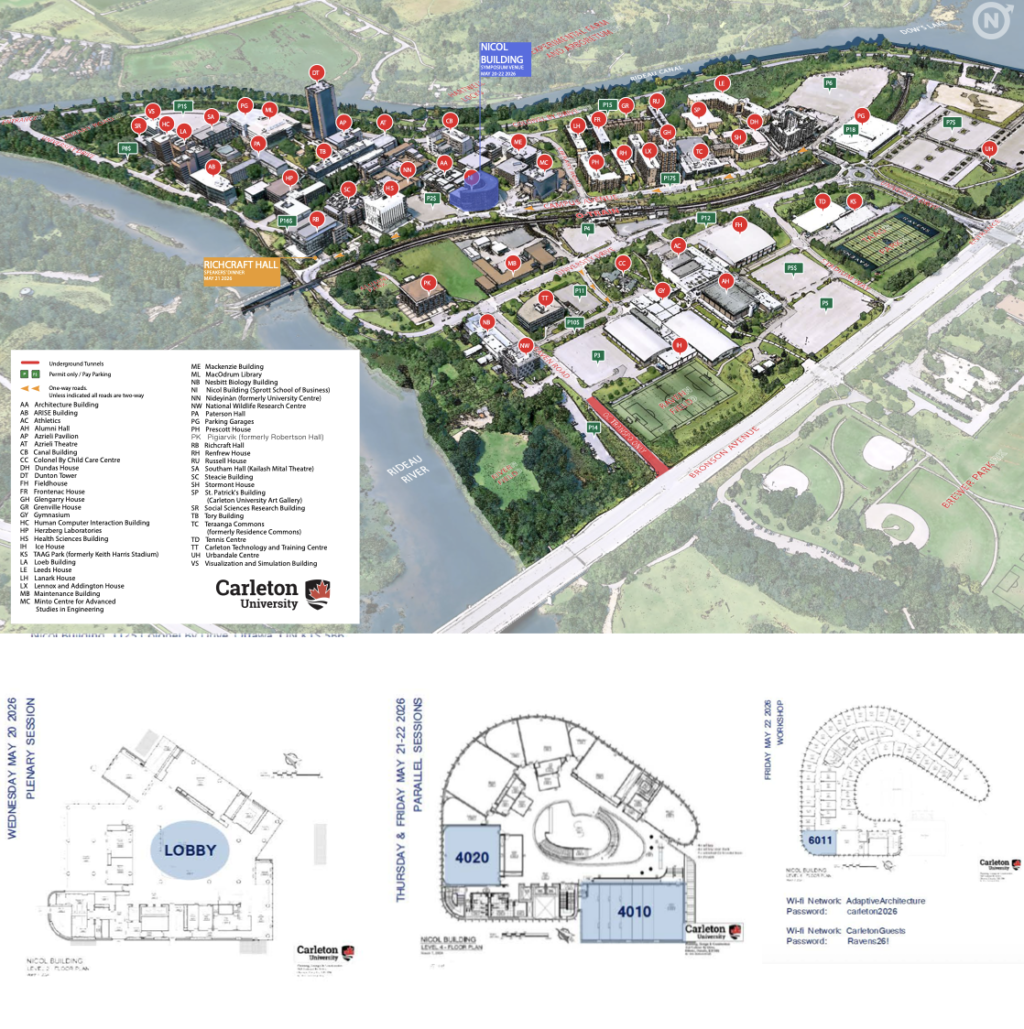
- Lobby, Nicol, Carleton University
- 1125 Colonel By Drive, Ottawa, ON, K1S 5B6
- Cost: $70.00 (in person), Free (virtually)
- Contact
- Federica Goffi, federica.goffi@carleton.ca
(from) Adaptive Reuse (to) Adaptive Architecture
May 20-22 2026
Nicol Building
Carleton University
Ottawa CANADA
Successful Event
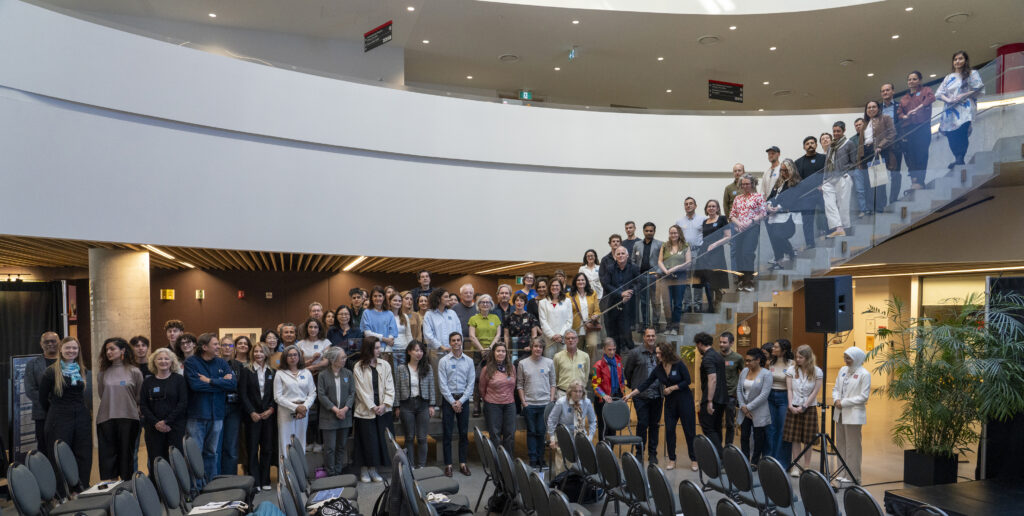
Thank you to all the sponsors, presentors and attendees. This was a well attended event full of engaging discussions and timely knowlege sharing.
About the Event
As American philosopher Nelson Goodman reminds us, every making starts not from nothing but from something. Despite the growing interest in ADAPTIVE REUSE since the 1970s in what is now considered an emerging discipline, there is not yet a well-formulated theory, nor the full awareness of how increasingly dominant it is becoming in the Architecture, Engineering and Construction industry (AEC).
While the adaptive reuse of various building typologies is nowadays a widespread practice–a radical cultural shift (from) ADAPTIVE REUSE (to) ADAPTIVE ARCHITECTURE would facilitate the transition from a widespread culture of new construction to a culture of adaptability in the field of architecture regardless of whether the building under consideration is new, pre-existing or designated heritage. Every building project could be approached from the perspective of its present (and future) ADAPTABILITY.
This event supports the redefinition of the boundaries between architectural design and ADAPTIVE ARCHITECTURE to explore meaningful theories of alterations of new or existing buildings, arguing that all past is present and that all making is a remaking.
ADAPTIVE ARCHITECTURE is an attitude towards the built environment. The topic has global relevance in current sustainability and environmental challenges. Despite the evolution and creation of pedagogical curricula that embrace the culture of re(use) and re(cycle), architecture schools are still predominantly focused on new construction, even when many projects in the building industry deal with remodelling and adaptations of existing and historic buildings. A few publications have begun to address adaptive reuse theories, including their relations to heritage practices. In architectural design, projects often start not from something but from scratch, each time anew, even though all places and sites have deeply situated histories. In this context, an in-depth study providing an international perspective on adaptability in architecture (whether this refers to new construction or building alterations) is much needed. Adaptability practices and the associated technologies are becoming increasingly indispensable for practicing architects.
Adaptability often gives rise to interpretive conversions aimed at recontextualizing ideas, details, or buildings along with their sites through re-design, forming de facto a project within an(other) project, or a story within an(other), allowing to re-enter a pre-existing reality anew (physically and culturally) through radical re-interpretations. With this in mind, we ask what stories emerge when places evolve, telling stories and contributing to an inclusive and diverse sense of cultural orientation through architectural adaptability.
Contemporary material conservation practices and policies examined in the context of emerging critical conservation theories, highlight social and cultural sustenance and sustainability, as well as questions of equity and inclusivity in the renewal of cities. The study of climate adaptation, deep retrofitting and vulnerability assessments can further expand these themes.
Transhistorical adaptability suggests that places are constructed by merging unfinished stories. Adaptability is a market-driven material and technological practice that is socially and culturally oriented.
This event builds on the Quality in Canada’s Built Environment: Roadmaps to Equity, Social Value and Sustainability research led by Canada Research Chair Jean-Pierre Chupin, Montreal University, which addresses the diversity of public environments impacting the everyday life of millions of Canadians in urban spaces, buildings and landscapes, addressing these four research clusters, which paper proposals can address:
1. Spatial justice and heightened quality of life.
2. Integrated resilience, material culture and adaptative reuse.
3. inclusive design for health, wellness, ageing and special needs.
4. processes and policies supporting the reinvention of built environments.
The Convenors of the event are Dr. Federica Goffi, author of the call of papers, Dr. Mariana Esponda, and Dr. Mario Santana Quintero.
We are honored that along with the keynote speakers, Dr. and architect Wanda Dalla Costa (Arizona State University, US), architect Sybil Mckenna (EVOQ Achitecture, Canada), architect Héctor Fernández Elorza (hfe architecture, Spain), Dr. Rumiko Handa (University of Nebraska-Lincoln, UNL, US) and Dr. Liliane Wong (Rhode Island School of Design, RISD, US), 101 scholars will present 72 papers dealing with case studies in Angola, Australia, Bangladesh, Belgium, Brazil, Canada, Chile, China, Columbia, Cyprus, Denmark, France, Germany, Greece, Holland, India, Italy, Japan, Luxemburg, Mexico, Poland, Portugal, South Africa, Spain, Sri Lanka, Sweden, Taiwan, Turkey, UAE, UK, US. The Canadian case studies explored by presenters are located in Gatineau, Halifax, Montreal, Ottawa, Toronto, Vancouver.
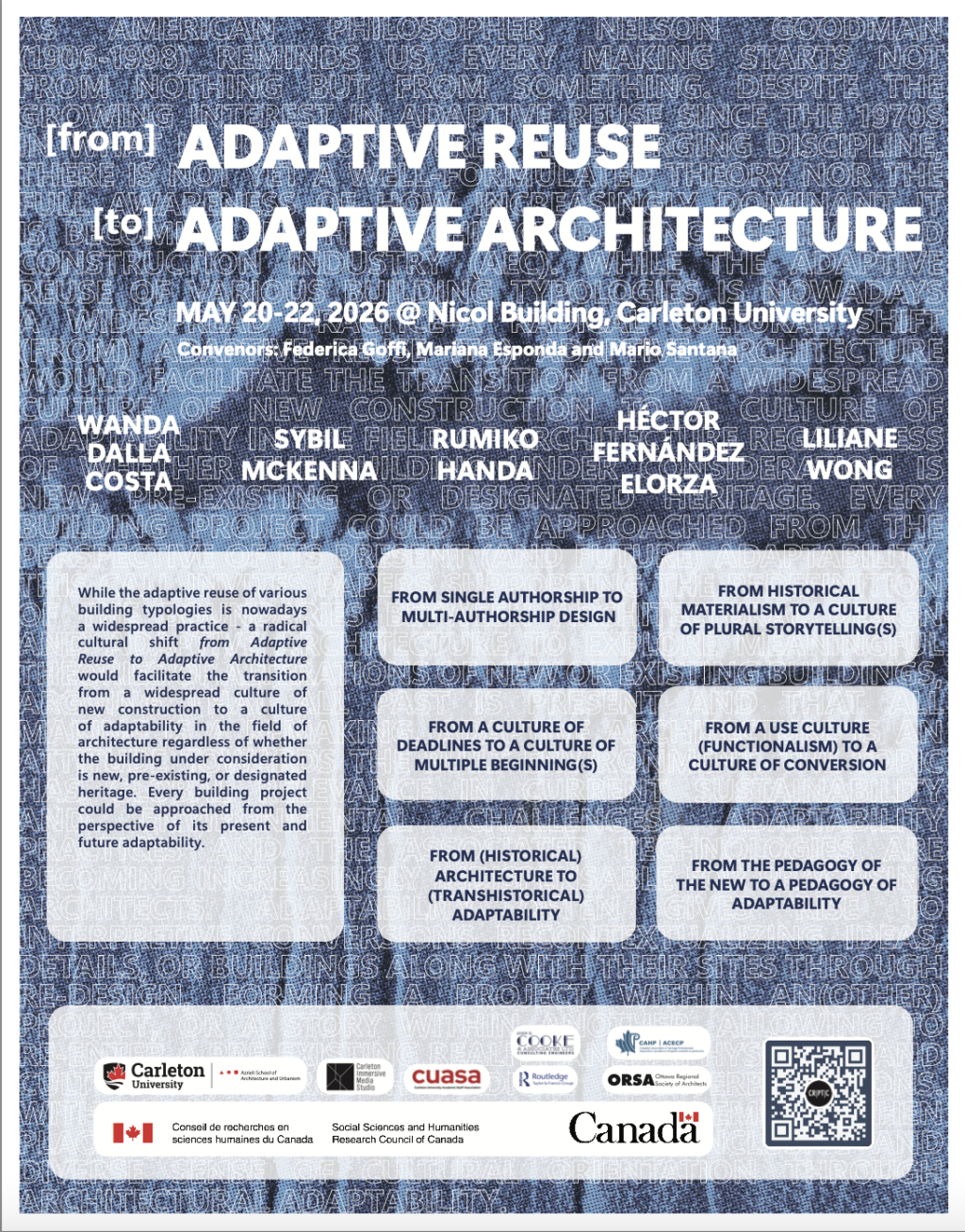
[from] Adaptive Reuse [to] Adaptive Architecture International Symposium is generously supported by professional and academic institutions, including the Social Sciences and Humanities Research Council Connection Grant (SSHRC Connection), the sponsorship of the Ottawa Regional Society of Architects (ORSA), The Canadian Association of Heritage Professionals (CAHP-ACECP), John G. Cooke & Associates Ltd., Routledge, Francis and Taylor Group, Publisher of Professional & Academic Books, Faculty of Engineering and Design, Carleton University), Carleton Immersive Media Studio (CIMS), and the Azrieli School of Architecture and Urbanism (ASAU).
Keynote Speakers
Wanda Dalla Costa
ARCHITECT TAWAW
Wanda Dalla Costa, AIA, FRAIC, LEED A.P. is a member of the Saddle Lake Cree Nation. Her firm, TAWAW Architecture Collective (www.TawArc.com) has offices in both Phoenix and Calgary. At Arizona State University, she is the founder of the Indigenous Design Collaborative, a community-driven design and construction program, which brings together tribal community members, industry and a multidisciplinary team of ASU students and faculty to co-design and co-develop solutions for tribal communities. Her teaching and research are focused on Indigenous ways of knowing, co-design methodologies, and the resiliency of vernacular architectures. Dalla Costa received an Honorary Doctorate in 2023 from Athabasca University. In 2022, she was recognized as an Honorary Fellow of the Royal Architecture Institute of Canada, and in 2019, she was recognized as a YBCA 100 recipient by the Yerba Buena Center for the Arts, a list which celebrates people, organizations, and movements shifting culture through ideas, their art, and their activism.
Sybil McKenna
ARCHITECT EVOQ Architecture
Sybil McKenna has played key roles in numerous planning, architectural and heritage projects, with mandates for the Parliamentary and Judicial Precincts in Ottawa including the Master Plan for Blocks 1, 2, and 3, and the current Block 2 Redevelopment. With 30 plus years of experience in Canada, the United States, and China, she is a seasoned architect and skilled communicator. Throughout her career, and in parallel with her architectural practice, Sybil has been a guest design critic at architecture schools across North America and has held appointments at The Ohio State University, Carleton University, and McGill University, where she teaches architectural design.
Héctor Fernández Elorza
ARCHITECT
Héctor Fernández Elorza, PhD, is a Lecturing Professor in Architectural Projects at the Escuela Técnica Superior de Arquitectura de Madrid, ETSAM since 2001. He has been a Visiting Professor at numerous institutions, including the Escuela de Arquitectura de Zaragoza & ETSAB-Barcelona (Spain), Universitá Di Roma “La Sapienza”, Fachhochschule Köln (Germany), NTNU University in Trondheim (Norway), Kunstakademiets Arkitektskole in Copenhague (Denmark), KTH University in Stockholm (Sweden), Universidad Católica de Rio de Janeiro (Brasil), University of Belgrade (Serbia), the Royal Institute of British Architects-RIBA, and the Cooper Union. In 2000 and 2012 he participated at the Biennale di Architecture di Venezia. As practicing architect, he designed and built the Mausoleum for the oceanografist Odón de Buen; the Auditorium and Documentation Centre of Contemporary Architecture in “Nuevos Ministerios” (Madrid); the Agricultural park, Valdefierro´s park (Zaragoza). He is author and co-author of E. G. Asplund, Exposición de Estocolmo 1930; Babelia; Pensar con las manos and Materia y material, La ortografía del espacio y el alfabeto de la estructura; Chicago-Nueva York y Arqueología Contemporánea. His work has been showed widely in Spain and abroad. In 2009 and 2010 he has been awarded the ROMA PRIZE (Spanish Academy in Rome).
Rumiko Handa
ARCHITECT
Rumiko Handa is Professor Emerita of Architecture at the University of Nebraska-Lincoln, USA. She is a registered architect, and holds a Ph.D. in Architectural Theory from the University of Pennsylvania and a B.Arch. from the University of Tokyo. She received the American Institute of Architecture Students’ 2001-2002 National Educator Honor Award. She is the author of Allure of the Incomplete, Imperfect, and Impermanent and Presenting Difficult Pasts through Architecture and a co-editor of Conjuring the Real: The Role of Architecture in Eighteenth- and Nineteenth-Century Fiction. Her writings also have appeared in: The Journal of the Society of Architectural Historians; Design Studies; Interiors: Design, Architecture, Culture; Preservation Education & Research; The Papers of the Bibliographical Society of America; etc. She lives in Lincoln, NE, and loves to travel.
Liliane Wong
ARCHITECT
Liliane Wong is Professor at the Rhode Island School of Design where, for more than a decade, she was Chair of the Department of Interior Architecture. Her interest and teaching in adaptive reuse led her to co-found the Int|AR Journal that promotes explorations of sustainable environments through exemplary works of reuse. She was recognized by Design Intelligence for 2018-2019 and 2019-2020 as one of the top 25 most admired design educators in the US.
She is the author of Adaptive Reuse in Architecture: A Typological Index, Adaptive Reuse_Extending the Lives of Buildings, co-author of Libraries – A Design Manual Manual, co-editor of Adaptive Reuse: A Decade of Responsible Practice.
A long-time volunteer at soup kitchens, her teaching emphasizes the importance of public engagement in architecture and design. Recent projects include Crossing the Pell, an interactive/experiential exhibition on adapting infrastructure, Don’t You Sit Down, an installation on segregation and Jim Crow laws, Projecting Change, a community exhibition on the future of coastal neighborhoods and Saving Superman, a reuse of an Art Deco high-rise.
Liliane Wong received her BA in Mathematics from Vassar College and her MArch from the Harvard University Graduate School of Design.
A registered architect in Massachusetts, she has practiced through her own firm, Mahon Wong Associates as well as with the Boston firms of Perry Dean Rogers and FHCM.