ASAU PhD Student Sally El Sayed Awarded Prestigious iBET Momentum Fellowship
The Azrieli School of Architecture and Urbanism (ASAU) is proud to congratulate PhD student Sally El Sayed on being named the 2026 recipient of Carleton University’s iBET Momentum Fellowship.
The iBET Momentum Fellowship recognizes exceptional doctoral students whose research demonstrates the potential to address complex societal challenges through interdisciplinary collaboration. The fellowship supports emerging researchers as they pursue innovative work that bridges engineering, design, technology and the built environment.
For El Sayed, the fellowship is both an affirmation of the work she has already accomplished and an opportunity to deepen research that has been years in the making.

“It allows me to have a little bit of backing toward what I’m doing and to be part of a cohort of other people who are also having similar experiences,” she says. “It’s also reassuring to feel supported financially so I can focus on the research itself.”
Although she officially began her PhD this year, El Sayed is no stranger to ASAU. After completing both her Bachelor and Master of Architecture at Carleton, she spent the past five years building an impressive research portfolio focused on equity, housing, community planning and participatory design. Working alongside Assistant Professor Menna Agha and the Action Lab, she has contributed to design-build projects, housing research, community-based initiatives and the Black Planning Project in Toronto, which examined the historical displacement of Black communities.
“I’ve always been doing this work,” she explains. “I’ve just been doing it in different places and in different forms.”
Now, as a doctoral researcher, El Sayed is bringing those experiences together into a research agenda centered on grassroots architecture—exploring how community-led design can move beyond filling gaps left by institutions and instead contribute to lasting structural change.
Rather than viewing architecture as something imposed from the top down, her research asks what becomes possible when communities shape their own spaces.
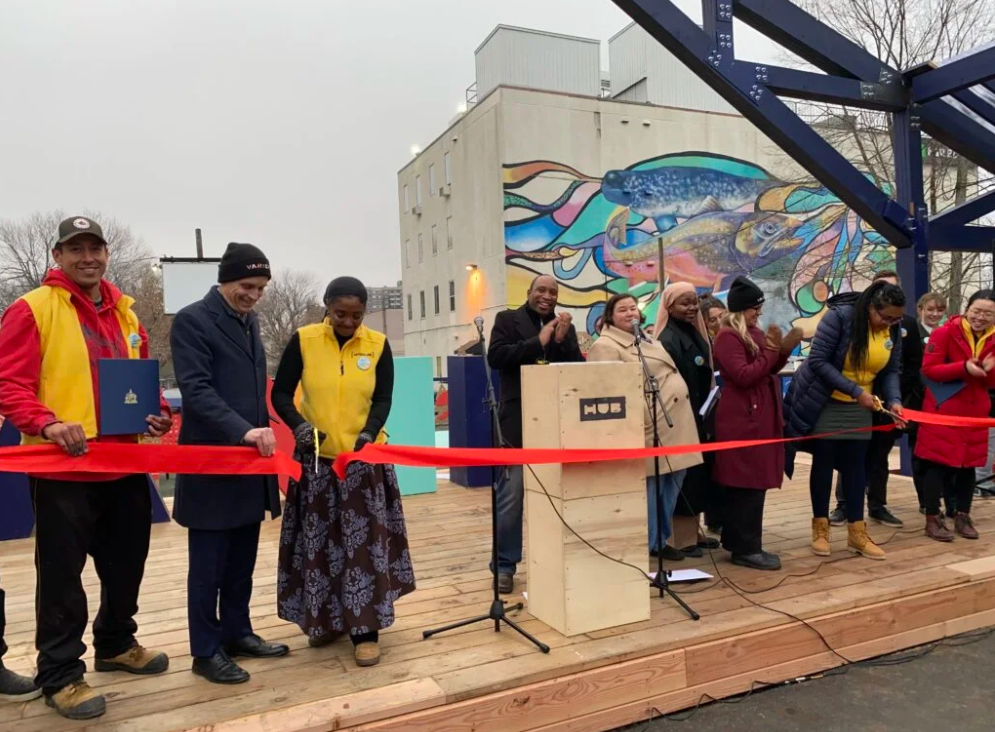
“Grassroots work means starting from the bottom up,” she explains. “Communities already have the knowledge, the programming and the work happening. What they often lack is infrastructure—not knowledge. It’s about listening to communities and redirecting resources to support what they already know they need.”
Her research examines whether architecture can become more than a temporary response to systemic inequities.
“I’m interested in asking whether architecture can actually create structural change,” she says. “Or is it simply a temporary solution to a problem?”
Growing up in Ottawa Community Housing helped shape both her perspective and her commitment to this work.
“I’ve seen firsthand how important public space and public infrastructure are for building community,” she says. “Access to these spaces gives people dignity, belonging and authority over their own neighbourhoods.”
Rather than focusing on a single community, El Sayed hopes her research will examine broader systems while drawing lessons from multiple grassroots initiatives. Her goal is to understand how community-led architectural projects can influence policy, governance and the ways resources are distributed.
The iBET Momentum Fellowship will also allow her to pursue the action-oriented approach that has defined her career. Rather than producing research that remains confined to academic journals, El Sayed hopes to test ideas through practice.
“I’ve always been oriented toward action,” she says. “Research shouldn’t just sit on a page. Especially when you’re working with vulnerable communities, research can become extractive if you’re not offering something back.”
Looking ahead, El Sayed hopes her doctoral work will combine rigorous scholarship with real-world implementation—testing new models of community-led design while contributing to broader conversations about equity, care and the future of architecture.
She also offers advice to students considering research careers of their own.
“Know what you care about,” she says. “Stay rooted in your values. Architecture can pull you in a million different directions, but if you’re grounded in what matters to you, your work will always have consistency.”
While her path has included research, podcast production, community planning, mapping and hands-on design-build projects, El Sayed sees them all as connected by a common purpose.
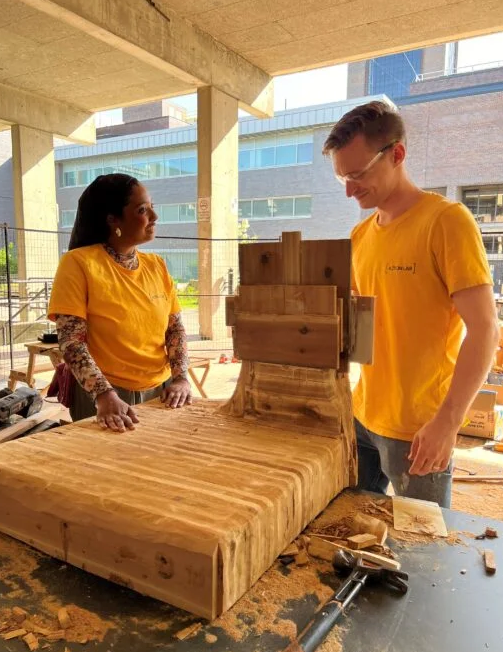
“Don’t worry so much about scaling up,” she says. “Go deeper. The more you invest in the issues you truly care about, the more you’ll discover exactly where you need to be.”
As she begins her doctoral journey, the iBET Momentum Fellowship provides both recognition of the impact she has already made and momentum for the work still to come. With a research program rooted in collaboration, action and community knowledge, El Sayed is helping reimagine what architecture can accomplish when it starts by listening.