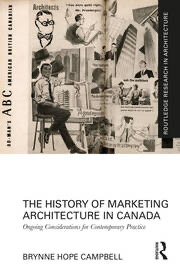
Rethinking the Role of Marketing in Architecture
In her new book, The History of Marketing Architecture in Canada: Ongoing Considerations for Contemporary Practice, Dr. Brynne Campbell explores how architects have communicated their value, navigated professional identity and promoted their work from 1955 to the present.
What does it mean to communicate the value of architecture? For Dr. Brynne Campbell, an Azrieli School of Architecture and Urbanism (ASAU) alumna, this question has become the focus of years of research, culminating in her newly published book, The History of Marketing Architecture in Canada: Ongoing Considerations for Contemporary Practice (Routledge, 2026).
Drawing on her doctoral research at Carleton University, the book examines how Canadian architects have approached marketing, business development and professional identity over seven decades. Through historical analysis, archival research and firm case studies, Campbell reveals how attitudes towards marketing have evolved while many of the profession’s underlying challenges have remained remarkably consistent.
From architectural practice to an unexpected research interest

Campbell’s journey into architectural marketing began with a realization that traditional architectural practice was not the direction she wanted to pursue. After completing her architectural studies and beginning her internship, she accepted a marketing coordinator position at an architecture firm. The experience introduced her to the business and communications side of the profession, including how firms position themselves, secure projects and communicate their value to clients and the public.
Without a formal background in marketing, she became fascinated by how architects explain what they do and why their work matters. She was also intrigued by the profession’s sometimes negative perception of marketing, which was often treated as an uncomfortable or even inappropriate part of architectural practice.
Her curiosity eventually developed into doctoral research, which she defended at Carleton’s Azrieli School of Architecture and Urbanism in November 2022.
The resulting book addresses an important gap in Canadian architectural history. While individual studies had explored aspects of architectural promotion and professional identity, Campbell recognized the need for a more comprehensive examination of how these ideas developed within the Canadian profession.
Understanding the architect’s evolving identity
Through an examination of historical publications, professional discourse, regulatory restrictions and architectural firm case studies, Campbell traces the relationship between marketing and architecture from 1955 to today.
One of her most interesting findings is the persistence of the profession’s concerns. Despite significant changes in technology, communication platforms and business practices, architects continue to grapple with familiar questions: How do we help the public understand what we do? How do we communicate our value? And how do we distinguish ourselves when competing for work?
“There’s not one single way to be an architect, there’s no right way, it’s just there’s lots of different ways to practice architecture and to have different skill sets,” she explains.
This more nuanced understanding of professional identity is particularly relevant as the next generation of architects enters a changing profession, where design expertise increasingly intersects with business, communication and collaboration.
Rethinking marketing as part of architectural practice
A central argument of Campbell’s book is that marketing should not be confused with simply selling services. Rather, it is about understanding audiences, communicating shared values and building relationships.
Her research highlights how architectural firms have historically used branding, storytelling and public relations to articulate their value. One example is Parkin Architects, whose corporate identity and marketing materials were carefully aligned with the expectations and language of its target clients.
For Campbell, this illustrates an important lesson: architects need to understand their audiences and communicate in ways that resonate with them, rather than relying exclusively on architectural terminology.
She believes this conversation is particularly important for architectural education. While professional practice courses introduce students to the business side of architecture, she sees an opportunity to place greater emphasis on communication, storytelling and the ability to articulate the value of architectural work.
As marketing tools and platforms continue to evolve, she believes the fundamentals remain the same: telling meaningful stories, connecting with clients and amplifying the good work architects are already doing.
Research with an impact beyond the classroom
Campbell credits her doctoral experience at Carleton University with developing the research skills that made the book possible. The program encouraged her to ask deeper questions, engage critically with archival material and bring together different perspectives to build a comprehensive understanding of complex topics.
She also deliberately sought expertise beyond architecture to ensure her research on marketing was both rigorous and relevant. She recognizes her doctoral supervisor, Dr. Federica Goffi, for her guidance and encouragement throughout the process, as well as the support of her broader supervisory team.
The book, published by Routledge as part of its Routledge Research in Architecture series, is intended as a resource for architects, academics and the wider professional community. It invites readers to consider how historical attitudes towards marketing continue to shape contemporary practice and how the profession might approach these questions differently in the future.
Today, Campbell is the Marketing Director at Figurr Architects Collective, an architecture firm with offices in Ottawa and Montreal. Her professional work brings together her academic research and passion for architectural storytelling through text and images, helping architects showcase their work and communicate their distinctive value.
For current graduate students and emerging researchers hoping to turn their work into published contributions, Campbell offers a reminder that meaningful research is built through patience and consistency. Rather than becoming overwhelmed by the scale of a project, she encourages students to trust their research, set manageable goals and recognize that small steps accumulate over time.
Ultimately, The History of Marketing Architecture in Canada asks the architectural profession to reconsider its relationship with marketing and recognize communication as an essential part of practice. By examining the profession’s history, Campbell hopes to encourage architects, educators and professional organizations to move beyond longstanding assumptions and better equip future generations to communicate the value of their work.
Book: The History of Marketing Architecture in Canada: Ongoing Considerations for Contemporary Practice
Author: Dr. Brynne Hope Campbell
Publisher: Routledge, 2026
Availability: Hardback, paperback and e-book through Routledge; digital access through Carleton University’s MacOdrum Library